/// FISSION AND FUSION, EXPLAINED LIKE YOU ARE FIVE
Fission and Fusion, Explained Like You Are Five
Why breaking atoms apart and crushing them together both release stupid amounts of energy, how power plants use each, and why fusion is always 30 years away.
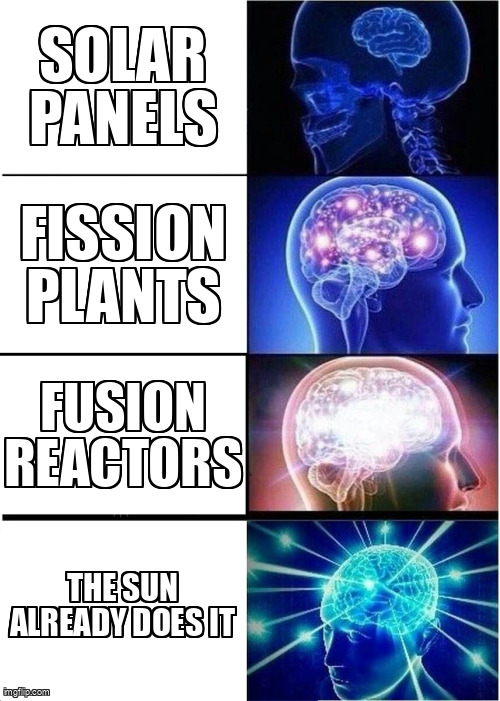
The sun is a fusion bomb that never stops exploding, held together by its own weight. Humans learned to split atoms before we understood them, and we are still learning to squeeze them. It is the universe’s oldest power plant, and we are still reading the manual with a flashlight. This is the story of both, no physics degree needed.
Mass is frozen energy
Einstein’s famous equation says mass and energy are the same stuff in different outfits. Mass is energy standing still. A paperclip holds enough frozen energy to power a city, if you could thaw all of it. Nuclear reactions thaw a slice of it. Burning coal only rearranges the outfits. Nuclear reactions change the actors. That is why a kilogram of uranium outruns tons of coal. It is not a better fire. It is different bookkeeping.
Why heavy atoms split
Some atoms are wobbly. Uranium-235 is a big nucleus barely holding itself together. Fire one neutron at it and it tips over, breaking into two smaller atoms plus two or three fresh neutrons, plus a burst of energy from leftover mass that no longer fits anywhere.
Those fresh neutrons fly off and tip neighboring atoms, which tip more atoms. One split becomes two, two become four. The classic image is mousetraps loaded with ping-pong balls: set one off in a room full of them and the whole room pops. That is a chain reaction. A bomb lets it run wild. A power plant keeps it at a simmer, roughly one new split per split, forever.
Why light atoms fuse
Hydrogen nuclei all carry positive charge, and like charges push apart. Try to push two together and they fight you the whole way. This push is called the Coulomb barrier, and beating it means squeezing harder than anything on Earth normally squeezes.
The trick is heat. Heat is atoms moving fast. Hot enough, and hydrogen nuclei slam together so hard they stick, merging into helium plus a burst of energy from mass that no longer fits. Same discount as fission: the merged atom weighs slightly less than its parts, and the missing bit becomes heat and light. Picture squeezing two magnets together against their will until they click into a new shape. The click is sunshine.
The iron valley
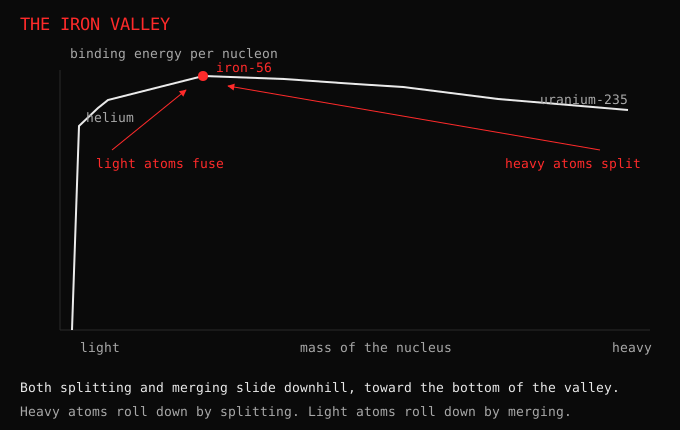
Here is the pretty part. Both splitting and squeezing release energy because both slide downhill toward iron. Plot every atom by how tightly it holds together and you get a valley with iron sitting at the bottom. Heavy atoms roll down by splitting. Light atoms roll down by merging. Everything wants to be iron. Stars die trying.
How a fission plant actually works
Unhook the word nuclear and a fission plant is a kettle. Fuel rods full of uranium pellets sit in water. Neutrons split atoms, splits make heat, heat boils water, steam spins a turbine, turbine makes electricity. The nuclear part is just a very fancy fire under the kettle.
Three babysitters keep the kettle calm. The moderator slows neutrons down so they split atoms instead of zipping past. Control rods soak up extra neutrons like sponges. Push them in and the reaction slows, pull them out and it wakes up. They are the brakes, and they fail safe: power dies and they drop in by gravity. Coolant carries heat away. Around all of it sits a containment dome of steel and concrete, a building whose entire job is to shrug. Boring, layered, and safe when respected.
Chernobyl in one paragraph
In 1986 operators ran a safety test on a Soviet RBMK reactor with the brakes half pulled out and safety systems switched off, in a design that sped up when cooling water boiled away instead of slowing down. Power spiked, fuel burst, the roof blew off. There was no containment dome to catch it. Every disaster since gets compared to it, and every comparison misses that modern plants are designed so that exact sequence cannot happen: brakes that drop by themselves, physics that slows down when hot, domes that shrug.
How a fusion machine works
Fusion needs sun conditions without the sun, so machines cheat in three ways.
A tokamak is a donut bottle made of magnets. Superhot hydrogen soup called plasma races around the donut, never touching the walls because magnets hold it midair. Europe’s JET did this for decades. ITER in France is building the biggest one.
A stellarator is the donut’s weird cousin, twisted into a pretzel so the magnets grip the plasma steadier. Germany’s Wendelstein 7-X holds it for minutes at a time, which in fusion years is a marathon.
Inertial confinement skips magnets and goes for violence: stadium-sized lasers crush a frozen fuel pellet from all sides at once. America’s NIF did it in 2022 and got more energy out of the pellet than the lasers put in. The press called it ignition. It lit, briefly, gloriously.
A bathtub of seawater per lifetime
Fusion fuel is embarrassingly common. Half of it is deuterium, heavy hydrogen, sitting in seawater. One glass of water holds a serious amount of it. The other half is tritium, rare in nature but breedable from lithium, the same stuff in phone batteries. Back of envelope math says one bathtub of water plus a laptop battery of lithium covers one person’s lifetime energy use. The fuel is not the problem. The bottle is.
Waste and safety, honestly scored
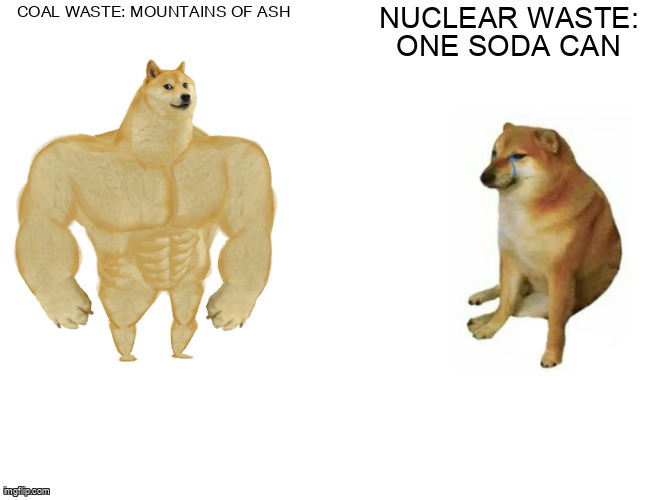
Fission waste is the real price. Spent fuel stays dangerous for thousands of years and needs guarding longer than any civilization has lasted. The volume is small, a soda can per person per lifetime, but small and hot for millennia is still a commitment your great-great-grandchildren did not agree to.
Fusion waste is mostly helium, the stuff in party balloons, plus reactor walls that turn mildly radioactive from years of neutron sandblasting. Those walls cool back down in decades, not millennia. And a fusion plant cannot melt down. Break anything and the plasma touches the wall, cools instantly, and the reaction just stops. No brakes needed when the fire goes out by itself.
Why fusion is always 30 years away
Plasma does not sit still. It wriggles, bulges, and escapes every magnetic grip engineers invent. Walls facing the plasma take a beating and need replacing. Tritium barely exists, so early plants must breed their own fuel while running. And breakeven has fine print: NIF beat the lasers, not the power bill of the whole building. Each milestone is real and each timeline is marketing. Fusion is always 30 years away because the last stretch keeps inventing new physics.
Every few months a headline announces the breakthrough that changes everything. Most change nothing this decade. I have started collecting them like stamps.
The Malaysian corner
Malaysia has quietly run a real reactor since 1982. The 1 MW TRIGA PUSPATI research reactor in Bangi makes isotopes for medicine and industry, trains engineers, and images things with neutrons. No power reactors, though the idea returns every few years with small modular reactors attached. Four decades of safe operation is a solid apprenticeship. If the country ever builds a power plant, it will not start from zero.
Your intuition about radiation is broken
You are radioactive right now. Bananas are radioactive. Sleeping next to another human doses you. Granite countertops hum. A cross-country flight gives you more radiation than living next to a nuclear plant for a year, because the sky is a leaky shield and altitude thins it. Nobody fears bananas. Everybody fears the plant. Your intuition measures scariness by movie count, not dose count. The unit exists, the sievert, and by that unit your kitchen fruit and your vacation flight beat the power station down the road. Fear is a terrible dosimeter.
The death scoreboard nobody reads
Count deaths per unit of electricity and the ranking flips every instinct. Coal kills roughly two dozen people per terawatt-hour: mining, hauling, burning, breathing. Oil sits close behind. Gas kills a few. Nuclear, with Chernobyl and Fukushima included in the math, kills a fraction of one. Wind and solar sit beside it. The safest machine on the grid has the scariest movies. Nobody made a horror film about a coal ash pond, and coal ash ponds kill quietly every year without a premiere.
We built the bomb first
Humanity unlocked destruction before electricity. The first mushroom cloud rose in 1945. The first grid-connected power plant, Obninsk in the Soviet Union, lit up in 1954. Nine years between weapon and kettle. Our species learned to end cities before it learned to boil water with the same fire. Every calm discussion about nuclear power descends from that original sin of priorities, and the technology has spent seventy years apologizing for its older sibling.
The waste paradox
Here is the paradox that breaks brains. A lifetime of nuclear electricity leaves a soda can of high-level waste, guarded for millennia. A lifetime of coal electricity leaves mountains of ash plus invisible gas poured straight into the sky, guarded by nobody, forever warming the climate. The scary waste is tiny and watched. The boring waste is gigantic and ignored. We demand ten-thousand-year plans for the can and accept no plan at all for the sky. Strictly by volume and damage, coal is the waste crisis wearing nuclear’s costume.
The one sentence version
Split the heavy, squeeze the light. Both slide toward iron and pay out energy. We mastered the split and babysit it in kettles. The squeeze needs a star in a bottle, and we are still building the bottle.
“Now I am become Death, the destroyer of worlds.”, Oppenheimer (2023), quoting the Bhagavad Gita. The man who unlocked the split, mourning the key.