/// MASTERY IS 80%
Mastery Is 80%
I followed every row and got 15/20. One rubric only allows 12 or 0 and Canvas says 9. The other has 17 rows and none of them were filled in.
Fifteen out of twenty. For a program that reads a number and prints a grade.
Somewhere, a marker looked at a two-option rubric and picked a third. We will get to that.
The brief: read a score from 0 to 100, print the alphabetical grade and the description, print an error message if the input is out of range. I have been paid to write code for six years. Twenty minutes, including the screenshot.
If you are the lecturer, hi. You look great. I have some questions about your rubric.
Five points I can live with. The rubric cannot explain them, and one of the scores is not a number the rubric allows.
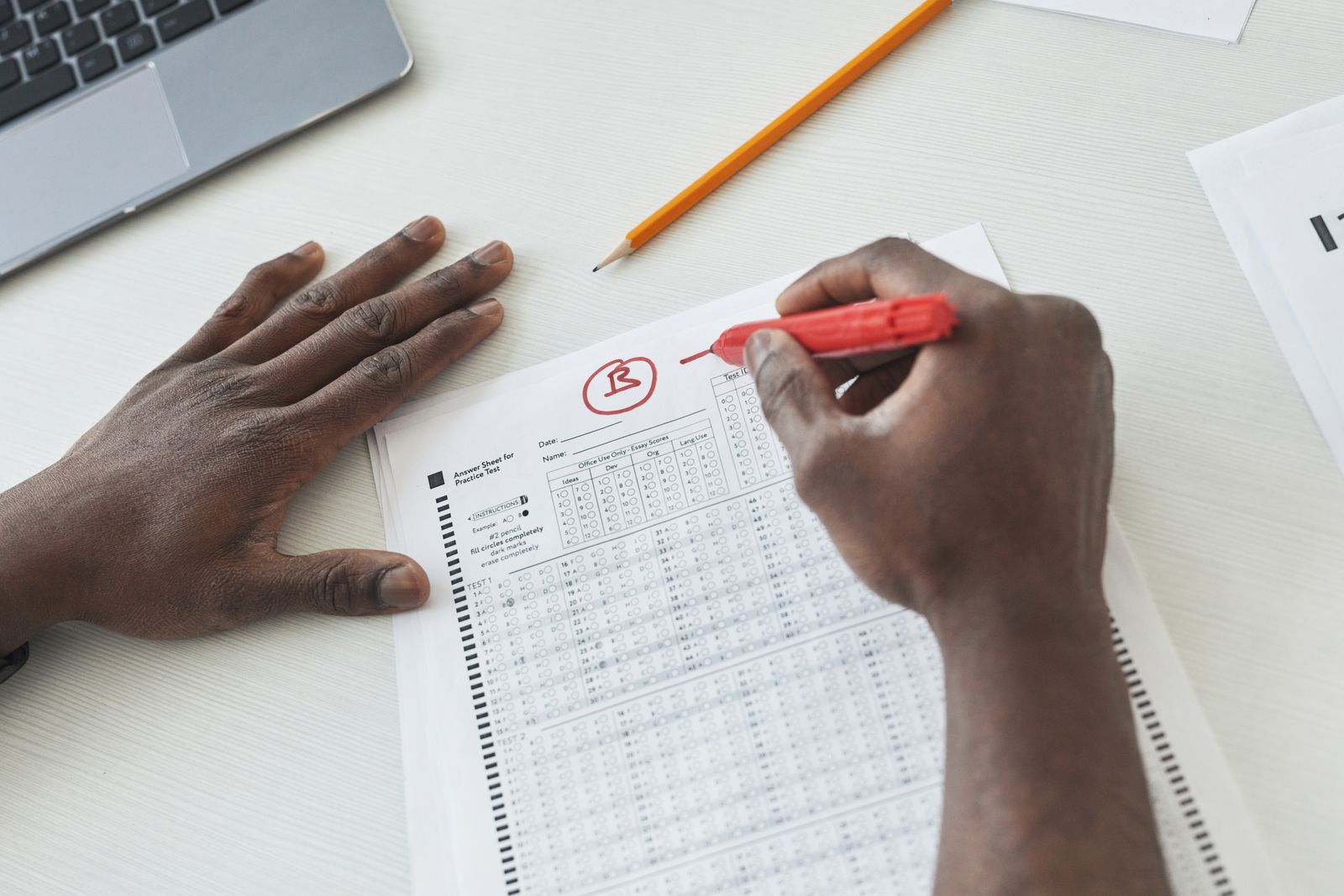
The damage
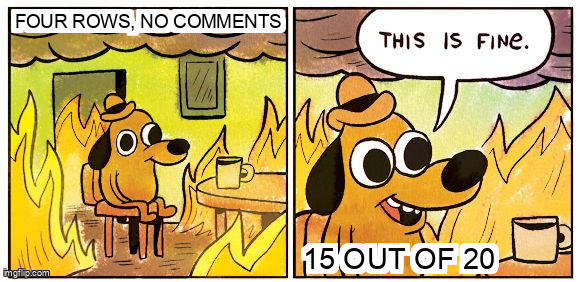
Four rows, twenty points:
- Input and error handling, 5 points
- Correct grade logic, 10 points
- Output, 3 points
- Code basics, 2 points
I got 4, 8, 2 and 1. Canvas calls it Mastery, Mastery, Near, Below. Nothing failed. Fifteen out of twenty. Somewhere, a tiny violin plays.
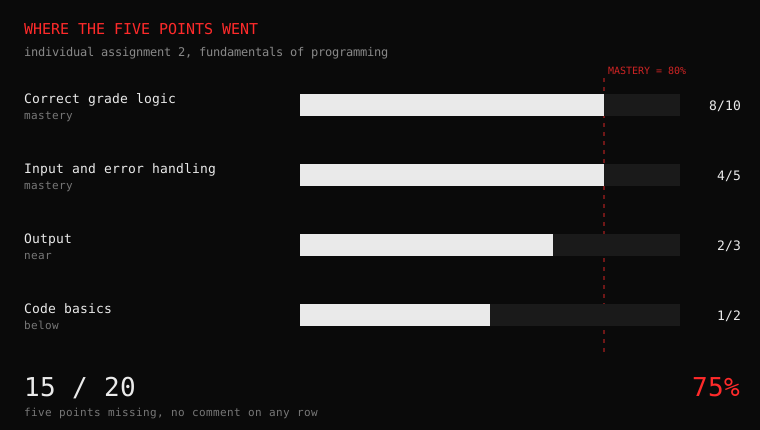
Mastery is 80%
Two rows have an Exceeds band above Mastery, worth the full points. Exceeds has no description. No sentence. No example. Not even a Lorem Ipsum.
So on those rows, Mastery is 80% of the row: 4 out of 5, 8 out of 10. Add it up. 4 plus 8 plus 3 plus 2 is 17. The best score you can reach using only the words on the page is 17/20. The last three points live in a band nobody wrote.
Then the rows stop agreeing with each other. Output tops out at Mastery, 3 out of 3, so there Mastery is 100%. Code basics tops out at Near, 2 out of 2. One word, three meanings. The rubric has more personalities than a reality show.
To get 20 I would not have to write better code. I would have to guess a description that was never written.
The score that does not exist
Assignment one is where the wheels come off.
The row is called Input Message and Scan Input, worth 12 points. The entire description is four words: “There are SIX numbers.”
The rating scale has two options. Full Marks, 12. No Marks, 0. That is it. A light switch.
Canvas says I got 9.
Nine. Not 12. Not 0. Somebody freehanded a 9 like they were drawing a circle in MS Paint.
I wrote six prompts, six reads and six variables. Count them. I can count to six. I have six years of experience and, allegedly, six numbers.
If the problem was the word “forth” instead of “fourth”, fine. Say that. But the rubric asks for six numbers, and six numbers walked in. Were they the wrong six? Did they have the wrong attitude?
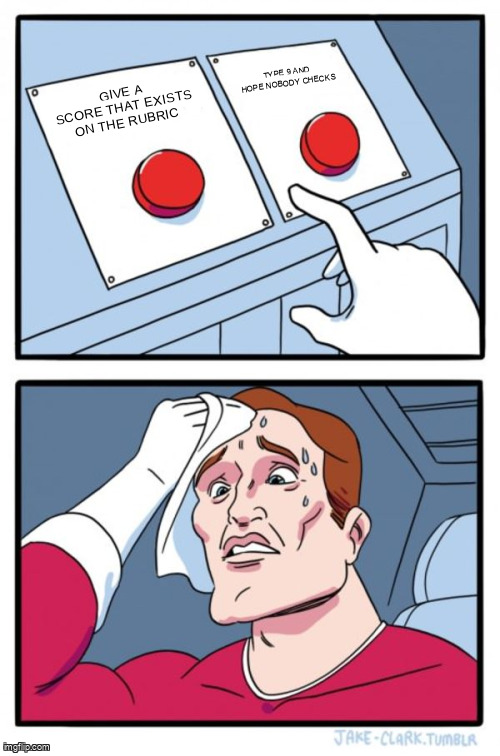
Code basics, allegedly
The Code Basics row is worth 2 points. The description:
- Code compiles and runs without errors.
- Variables are named sensibly, for example score, not x.
- Code is indented and readable.
I got 1 out of 2. Rating: Below.
Below what? Below sea level?
The code compiles. I ran it. The variables are score, grade, classification and points. It is indented. Which bullet did I miss? The font? Was it too spicy? Did a semicolon look at you funny?
Output is the same comedy. The row wants the alphabetical grade and the description. Mine prints Grade, Classification and Grade Point. More than asked. It got 2 out of 3, Near. Near what? Near the exit? Near the edge of your patience?
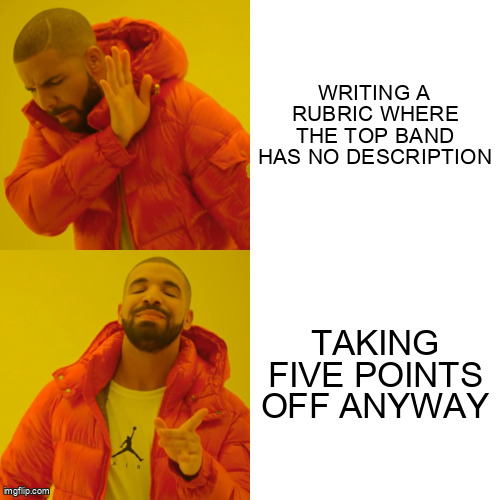
A receipt is not feedback
No comment on any row. Four numbers and a total, like a receipt from a restaurant that hates you.
Maybe the format was off. Maybe the error string had a stray space. Maybe my variable names were fine and the deduction is for a crime I cannot see. I can guess all day. Guessing is the problem.
If a lost point does not map to a line in the file, the score teaches nothing and checks nothing. Two people could mark the same program with this sheet and land on 15 and 18, both following the instructions. The rubric is a mood with a number stapled to it.
The same course gave me 100
The rest of the semester: quiz 10/10, quiz 10/10, the intro Java task 100/100, mid exam 36/40, final exam 48/60. The two assignments: 16/20 and 15/20.
Same student. Same language. Same semester. The tasks with a defined answer got full marks. The ones graded against an empty top band did not. Coincidence? Sure. A very consistent coincidence. Like a cat knocking over the same glass every night.
The other course is worse
Falsafah dan Isu Semasa: 47/50 on the quiz, 70/100 on the final report.
Seventeen-row rubric. Canvas has no assessment for it, and it says the rubric is not used for grading. So the 70 is not the sum of anything. It spawned. The rows are untouched. The rubric is wallpaper, and not the cheap kind.
Eleven of the seventeen rows say the same thing: if AI is detected in this content, half marks deducted. Detected by what? A vibe? A Magic 8 Ball? Name the tool. Version. Threshold. Otherwise it is a threat with a font.
Quiz with right answers: 94%. Essay with an unenforced seventeen-row rubric: 70%. The grade tracks how measurable the task is, not how well it was done.
About the final exams
Both final exams had mistakes. Not “I disagreed with the answer” mistakes. Wrong mistakes. A question with no correct answer is broken, not hard.
Who checks the question bank? A group chat at 1am? An intern on their first day? A coin flip? Somebody wrote it, somebody pasted it, and nobody read it twice.
I am told to double check my work. Fine. I do. But the people marking it do not double check theirs. The rubric has a score that does not exist. The exam has errors. The seventeen-row rubric is blank. At some point “high standards” means nobody looked.
Rigor cosplay
Now the theory.
Some lecturers shave points because a perfect score would make them look soft. The work is fine. But 20/20 feels like a gift, and 15/20 feels like a job. The optics need a haircut. The internal monologue writes itself: knock a few points off, so it looks like the course was properly assessed.
I call it rigor cosplay. The costume is a rubric. The prop is a red pen. The plot never changes: the student does the work, the lecturer takes five points, and everyone agrees the standard is high.
“Never give full marks.” “If everyone gets an A, the grade means nothing.” That is a reservation dressed like a standard. The last 20% is for the marker’s mood. Nobody wrote down what it rewards.
It is lame. I said it.
The revenge theory
And then there is my favorite theory.
Once upon a time, an assessor made your viva miserable. Asked a question you could not answer. Maybe smiled. Now, years later, the invoice goes to a room of students who were not there.
I do not know if that is true. I am not a therapist. But a rubric is not a revenge arc, and you are not the main character.
Nobody is perfect
You cannot give 20/20 because nobody is perfect. Cool. But the question bank is perfect. The rubric is perfect. The 9 out of 12 is perfect. The final exam with mistakes is perfect.
Funny how the perfection rule only applies to the people paying tuition.
What I am not saying
I am not saying I earned 20. I have shipped bugs. My error string could be wrong. I am not precious about being corrected.
I am not saying every lecturer is like this. The best ones marked hard and explained every point. The number was never the problem. The silence was.
I am saying the tool is broken. If the top of the scale has no definition, and the middle of the scale is a number that does not exist, the grade says more about the marker than the work.
Questions I would like answered
- What does Exceeds mean?
- Which of the six numbers was not a number?
- What input did you want? A haiku?
- How does 12 or 0 become 9? Is this jazz?
- Which Code Basics bullet did I miss? The font?
- Why does a seventeen-row rubric have zero filled rows?
- Which AI detector, what threshold? Name and version.
- Who proofreads the final, and can I have their number? Asking for a friend.
What a working version looks like
- Describe the top band with one example, or delete it and make the best described band worth full points.
- Use scores that exist on your own scale.
- One sentence per lost point. “Output: classification word missing” is enough.
- If AI detection carries half the marks, name the tool and the threshold, or drop the clause.
A stranger with the rubric and the file should be able to reproduce your number. If they cannot, it is a verdict with a rubric stapled to it.
I will email and ask what Exceeds means. Not for the five points. I want the sentence, so the next student does not have to reverse engineer a grade from a dashed line.
The code works, by the way. It has always worked. I checked. Someone else should try it.
Maximum effort. I gave it. Somebody on the other side of the rubric should try it too.